SIMP 6.4+: Design `simp environment` command
- Chris Tessmer
- Liz Nemsick
- Shark Bruhaha
This article began as an artifact of SIMP-6380 - Getting issue details... STATUS .
It describes the simp environment new command (and others), proposed in the decision log SIMP 6.4+: The ISO installation/Puppetfile workflow.
Design lineage
Terminology
(Mockup:) simp environment COMMAND [OPTIONS]
Manage and coordinate SIMP omni-environments
Usage:
simp environment COMMAND [OPTIONS]
Alias:
simp env
A complete SIMP environment (often referred to as the SIMP "omni-environment")
has three distinct sources:
* Puppet: Puppet code and data under $environmentpath/$environment/ * Secondary: Environment-specific SIMP data (e.g, site_files/) * Writable: Env-specific SIMP data created during compile (e.g., passgen)
The Secondary and Writable environment are collectively referred to as theSIMP "Extra" environment.
In order to compile the Puppet catalog, the Puppet server MUST be able to readfrom all three environments, and it MUST be able to write to the Writableenvironment. The Puppet and Secondary environment's assets MUST be available_before_ compiling the catalog.Files:
/etc/simp/simp_cli.yaml
Contains configurations for the simp cli command
simp environment new ENVIRONMENT [OPTIONS]
Create a new SIMP "Extra" (default) or "omni" environment
Usage:
simp environment new ENVIRONMENT [OPTIONS]
By default, this command will:

  * create a new environment (–-skeleton)
* raise an error if an environment directory already exists
It can create a complete SIMP omni-environment with --puppet-envExamples: # Create a new development "extra" environment simp env new development
# Link staging's Secondary and Writable env dirs to production simp env new staging --link production
# Create a separate copy of production (will diverge over time) simp env new newprod --copy production
# Create new omni environment, simp env new local_prod --puppetfile
Options:
option | purpose |
|---|---|
--skeleton | (default) Generate environments from skeleton templates. |
--copy ENVIRONMENT | Copy assets from ENVIRONMENT |
--link ENVIRONMENT | Symlink Secondary and Writeable environment directories |
Puppetfile options
option | purpose |
|---|---|
--[no]-puppetfile | Generate Puppetfiles in Puppet env directory |
--[no]-puppetfile-install | Automatically deploys Puppetfile in Puppet env |
Extra options
option | purpose |
|---|---|
--puppet-env-dir PATH | Parent directory for new Puppet environment dir |
--secondary-env-dir PATH |
|
--writable-env-dir PATH |
|
--[no-]puppet-env | Includes Puppet environment when `--puppet-env` |
--[no-]secondary-env | Skips the Secondary environment when `--no-` |
--[no-]writable-env | Skips the Writable environment when `--no-` |
Future options:
option | purpose |
|---|---|
--simp-mod-data-provider SRC |
|
|
|
|
|
simp environment update ENVIRONMENT [OPTIONS]
Update data in a SIMP "Extra" (default) or "omni" environment
Usage:
simp environment update ENVIRONMENT [OPTIONS]
Alias:
simp env up ENVIRONMENT [OPTIONS]
The only update the content of Puppetfile.simp.
Copy options:
option | purpose |
|---|---|
--copy ENVIRONMENT | copy assets from ENVIRONMENT |
Puppetfile options:
(same as simp environment new)
Extra options:
(same as simp environment new)
simp environment remove
Remove an entire SIMP extra-environment
Usage:
simp environment remove ENVIRONMENT [OPTIONS]
Alias:
simp env rm ENVIRONMENT [OPTIONS])
Remove an environment's assets/code/data from ENVIRONMENT'S directories.
Options:
Extra options:
(same as simp environment new)
simp environment mirror [ENVIRONMENT] [OPTIONS]
Alternate names considered: postrun, deploy, ensure
Ensure that a SIMP extra environment exists for each Puppet environment (under$environmentpathcreating or removing secondary and writable environments
until there is a 1:1 mapping.
When ENVIRONMENT is given, only that environment will be affected.
This command is useful to run after Code Manager/`r10k deploy environment` or a CodeManager run.
Usage:
# Ensure that a SIMP extra environment exists for each Puppet environment # (and remove any extraneous SIMP extra environments)
simp environment mirror [OPTIONS] # * If a Puppet environment exists at $environmentpath # that a corresponding SIMP extra environment exists, too. # * If not, ensure that there is no SIMP extra environment for `development` simp environment mirror development [OPTIONS]
Examples:
# Create a new development "extra" environment simp env new development
# Link staging's Secondary and Writable env dirs to production simp env new staging --link production
# Create a separate copy of production (will diverge over time) simp env new newprod --copy production
Extra options:
(same as simp environment new)
simp environment list
List SIMP omni environmentsUsage:
simp environment list [PATTERN] [OPTIONS]
Alias:
simp env ls ENVIRONMENT [OPTIONS]
option | purpose |
|---|---|
--details | Show table of component environments and status |
Examples:
# short list of environments $ simp env list
production development staging
     # component environment details
     $ simp env list --details
     | Env dirs:   | Puppet | Secondary | Writable |
     | ----------- | ------ | --------- | -------- |
     | production  | Yes    | Yes       | Yes      |
     | development | Yes    | Yes       | :x:      |
     | production  | Yes    | Yes       | Yes      |
simp environment fix ENVIRONMENT
Re-apply FACLs, SELinux contexts, and permissions to all omni-environment files
Usage:
simp environment fix ENVIRONMENT [OPTIONS]
Actions:
* Ensure SELinux contexts under all environment directories (`fixfiles restore`)* Restore FACLs under ${SECONDARY_ENVDIR} ${PUPPET_ENVDIR} ${WRITABLE_ENVDIR}`* If ${SECONDARY_ENVDIR}/FakeCA/cacertkey doesn't exist, fill it will random gibberish
Extra options:
(same as simp environment new)
simp environment validate [ENVIRONMENT] [OPTIONS]
Validates various things about an environment
Usage:
simp environment validate [ENVIRONMENT] [OPTIONS]
Checks include:
* FACLs, SELinux contexts, and permissions to all omni-environment files
* (Basically, everything that `simp env fix` would fix)Extra options:
(same as simp environment new)
simp environment export ENVIRONMENT FILE [OPTIONS]
Creates an encrypted tarball of ENVIRONMENT'S omni-environment
Usage:
simp environment import ENVIRONMENT FILE [OPTIONS]
Import an exported omni-environment back into ENVIRONMENT
Usage:
(This might only be relevant to environments provided by directories)
Implementation
Simp::Cli::Environment::
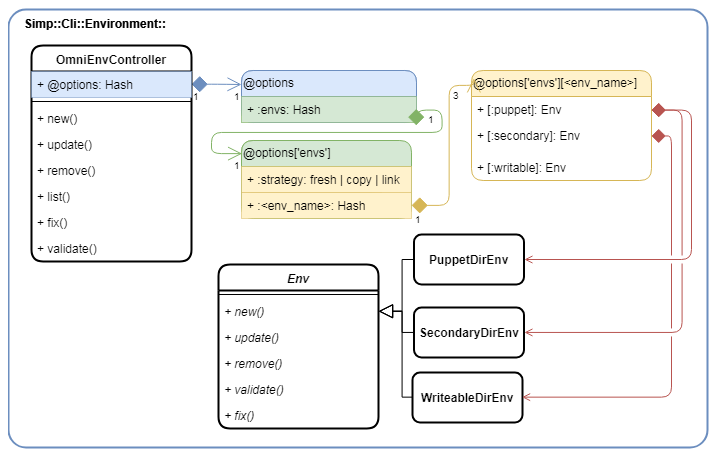
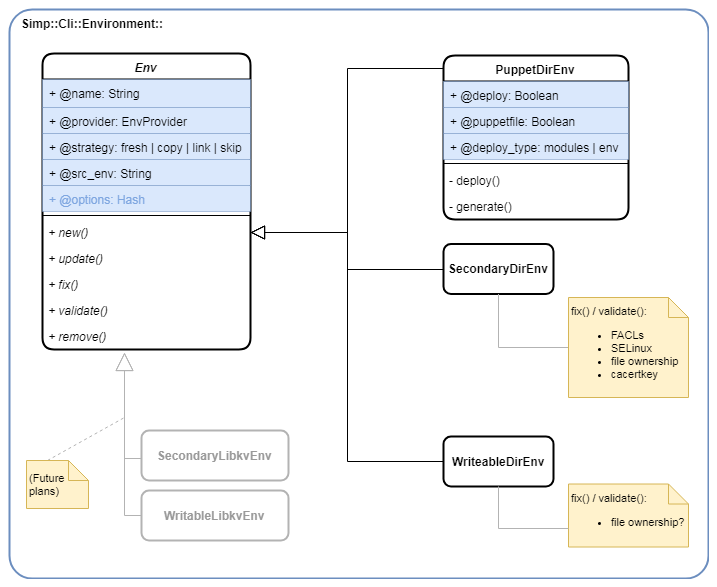
Simp::Cli::Commands::
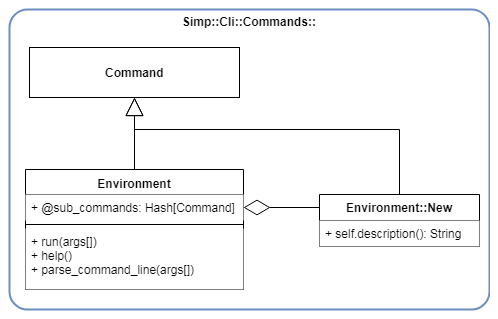
The simp environment COMMAND is composed of sub-commands, like simp puppetfile COMMAND.
Below are the relationships to compose simp puppetfile new: